
#TheyPersisted: Independent Media Endures in the Western Balkans
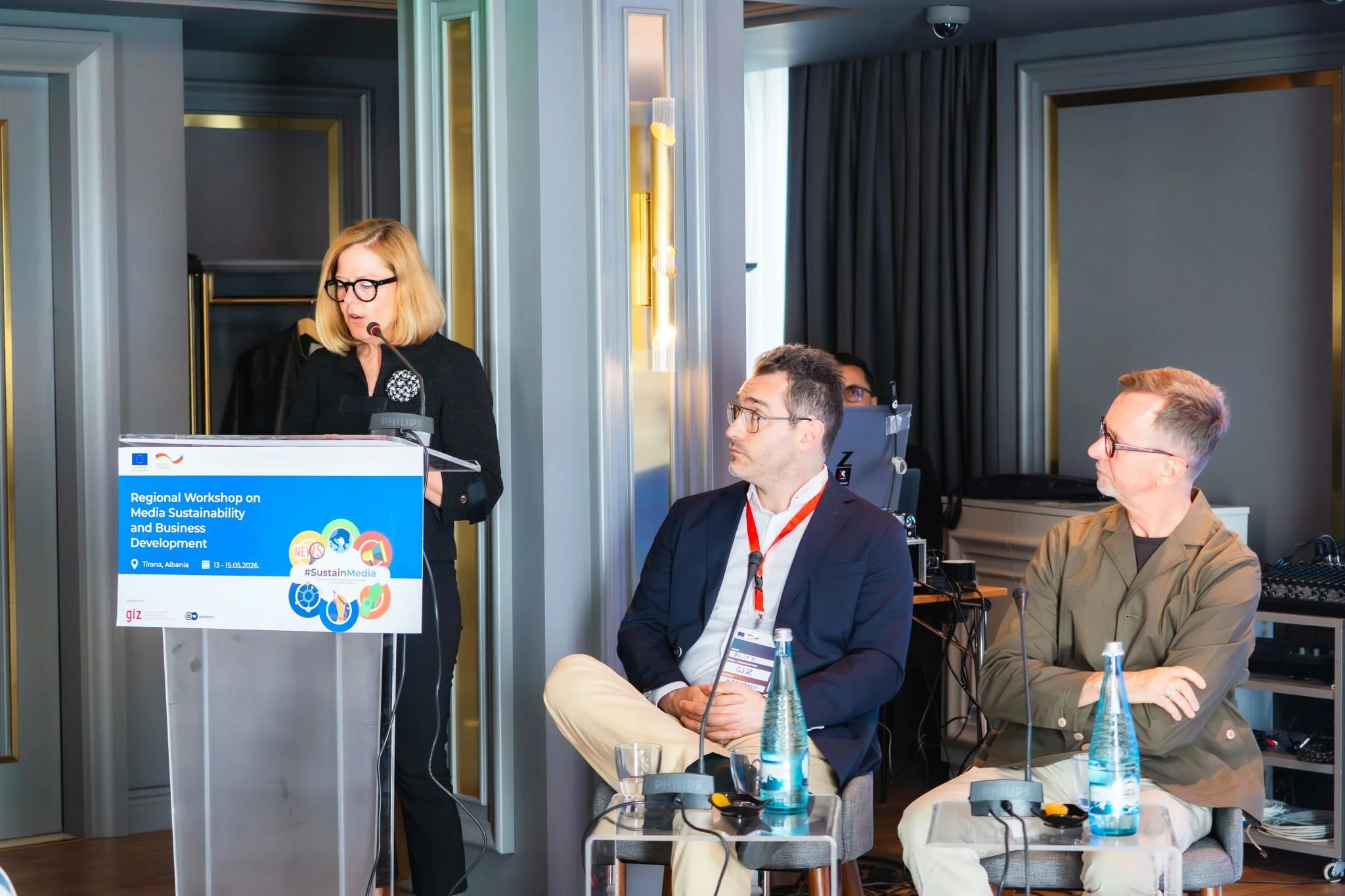
Remarks on May 14, 2026 at the Regional Workshop on Media Sustainability & Business Development in Tirana, Albania
My name is Shannon Maguire, and I'm the Senior Director of Development for the International Center for Journalists Plus, or ICFJ+.
Some of you know me from my previous role leading the media assistance portfolio for USAID's Europe and Eurasia Bureau, where I worked closely with GIZ, the Commission, and Internews to co-design and co-implement the Balkans Media Assistance Program — BMAP — alongside SustainMedia and its predecessor, Support to Media Freedom and Pluralism in the Western Balkans.
I'm not here as someone who watched this work from a distance. I have a personal connection to all of you. I know the challenges you've navigated. And I'm not here just as a former donor representative and now a practitioner — I'm also here as someone who has felt some of the disruption we're all experiencing, personally and professionally.
We are now a year and a half out from the events of January 2025, when USAID was dismantled and shut down almost without warning. And I want to be clear: while last year was extraordinarily difficult for so many of you, we are still here. And we still believe deeply in this work.
I also want to acknowledge the blunt reality of where we are.
Official Development Assistance for media — and most sectors — has undergone a historic contraction.
The closure of USAID removed the largest single funder of independent media worldwide, virtually overnight. It was around 20-25% of all global support to media.
The cascade effect was immediate.
As the DW Akademie's 2026 State of Media Development Report documents, only 11 percent of media development organizations now say they have sufficient funding — down from 18 percent the year before.
Private foundations have shifted priorities away from international media support. And public funders are redirecting resources toward security and defense.
But the funding crisis is not happening in isolation.
It is compounding headwinds that were already battering the sector before last year.
On press freedom: Reporters Without Borders’ 2026 index found that less than 1% of the world’s population lives in a country where the state of press freedom is “good.”
The V-Dem Democracy Report finds that the level of global democracy, weighted by population, has fallen back to 1978 levels.
Media workers face rising violence, political smears, surveillance, ownership concentration, and legal restrictions.
In this region, it’s not just that some programs have closed and partners are struggling for resources, but some have been subject to investigations and potential criminal charges.
On audience behavior and trust: the Reuters Institute's Digital News Report finds that news avoidance is rising, with 39 percent of people saying they actively try to avoid news.
AI-generated overviews now deliver information directly within search results, reducing click-through rates by nearly half. This shift means visibility no longer equals reach.
On the technological front: AI-generated disinformation is scaling rapidly.
The EU's report on Foreign Information Manipulation and Interference found that in 2025 alone, the European External Action Service documented hundreds of FIMI incidents globally, with at least 30 percent linked to Russia, 6 percent to China, and the rest were unattributed. The use of AI in these operations grew by more than 250 percent in a single year.
Still, I would argue these figures tell us something more. Even something hopeful.
If 99% of the world lives without a sufficient state of press freedom, that means independent media are finding how to report in imaginative and resilient ways.
In the face of news avoidance, outlets like yours are finding creative ways to educate, engage, and empower audiences.
And the changes in Hungary show that even after 15 years of steady democratic backsliding, a free press can endure.
So what do we do?
We cannot simply wait for ODA to return to what it was. The honest answer is that it will likely not.
What we can do — what we must do — is build differently.
That means being strategic with limited resources, and being willing to reimagine how we work.
I want to walk through four areas where I believe we have genuine opportunities to move forward. None of these are entirely new ideas. But this moment demands we take them seriously in ways we never quite have before.
First, and most fundamentally: we have to be honest that not every intervention can scale, not every model survives, and that working with less requires hard choices.
The first path forward is radical collaboration.
We talk about it a lot, yet often do it badly.
Dozens of organizations do overlapping work, compete for the same shrinking pool of grants, and duplicate tools and approaches.
We can't afford that anymore.
Before, we said “let a thousand flowers bloom”. But now, we need to make bouquets.
Radical collaboration is more than being in a working group or a coordination body.
It is organizations genuinely pooling capabilities, sharing risk, and building things together that none of them could build alone.
ICFJ+ is, I would argue, a real example of what this can look like.
ICFJ+ is a new joint organization formed by the International Center for Journalists in the US, Code for Africa in South Africa, and PROTO in India.
We are three organizations that could have remained separate, competing for the same funding.
Instead, we've combined journalism expertise and deep experience working with content creators and news influencers; civic technology; and systems-building capacity into something genuinely new — with shared governance, shared risk, and a commitment to deliver at scale in a transformed information environment.
The merger was planned before the US funding cuts hit — not as a reaction to the crisis, but because we saw that the general information needs landscape and the media sector were changing dramatically.
Our goal is to cultivate civic intelligence — helping people break through the information overload, make sense of their world, and act constructively to shape their communities.
The second strategic path is shared infrastructure.
The USAID collapse didn't just cut project funding — it cut the connective tissue of the sector.
And that points to a fundamental inefficiency we need to address.
We need to create systems that can withstand crisis, displacement, censorship, and attacks.
Too many small and medium outlets are trying to individually acquire and maintain enterprise-level tools — market research, audience development platforms, publishing stacks, revenue strategies, digital forensics tools, AI automation workflows — things that large organizations handle with dedicated teams.
Solo operators and small newsrooms covering climate, health, politics, and local issues often abandon their vital work simply because they lack the basic technical infrastructure to sustain it.
ICFJ+'s new initiative, the Plus Hub, is designed to address this directly.
The Plus Hub provides shared, enterprise-level technical services to news organizations and civic information actors that cannot afford these tools individually. Not just for a few weeks or months, but for the long-term.
Seed-funded by the Knight Foundation and Google News Initiative, and now with funding from NED, the Plus Hub delivers shared infrastructure across four layers:
foundational services like market validation, audience development, and publisher stack setup;
innovation services around platform optimization and revenue diversification;
institutional services like operational security, legal support, insurance, accounting, payroll;
and specialized editorial support including digital forensics, open source intelligence capabilities, fact-checking workflows, and even access to remote sensing technologies like drones and satellite imagery.
The Plus Hub works through cohorts and a peer learning approach — groups of information providers who share common challenges, including investigative journalists, news creators and influencers, exiled media, and grassroots hyperlocal outlets.
We know our partners aren't just dealing with knowledge gaps — they're dealing with resource gaps that training alone can't bridge.
Other organizations are doing similar work–Newspack offering platform hosting for local news sites in the US; GFMD’s journalism cloud alliance, allowing secure, distributed environments where data can be processed, and content and institutional memory can be protected and restored; and initiatives like OCCRP’s Reporters Shield and TrustLab with DWA and Code for Africa, which recognize that legal and digital safety must be collective, not individualised.
In a time of scarce resources, instead of dozens of organizations each building bespoke solutions, we should be investing in shared infrastructure that any information provider can plug into.
That is a fundamentally more efficient use of the funding we have left — and it frees up other assistance for core operating costs.
The second imperative is diversifying our revenue base — but with clear eyes about what that actually takes.
The sector must become legible to investors. That requires alignment on priorities, sustainable revenue models, and patient capital that genuinely understands media's public-interest mission — not standard small business financing structures retrofitted to a sector they weren't designed for.
If we know that entry points to investors are the first barrier, we also know that access alone is not enough. Investors need pipelines.
They need blended finance structures that leverage philanthropic and donor investment, along with risk guarantees.
Investors and capital need intermediaries who can translate between media economics and investment logic.
There are promising models.
In the Philippines, a multi-stakeholder public journalism fund is being built with local private sector and philanthropic engagement — not as a donor-imposed structure, but as a locally owned and led initiative.
There, local business associations are starting small, seeing how it goes, and scaling what works.
In Czechia, the Endowment Fund for Independent Journalism has distributed over €3 million to more than 120 independent media projects, operating with a governance structure that keeps both donors and journalists insulated from political pressure.
And across the Balkans, outlets like Citizens Channel, Radio 021, Zurnal, Vidi Vaka, and Kosovo 2.0 are finding ways to attract crowdfunding, membership drives, ethical advertising, and investment by social entrepreneurs.
These examples matter because they show what conditions make private capital possible: local ownership and leadership, clear governance that protects independence, patient capital willing to absorb early-stage risk, and proof-of-concept at a scale investors can evaluate.
And it's not up to investors alone. The recent Media Funding Policy Lab hosted by the Centre for Sustainable Media in Brussels — bringing together practitioners, funders, and policymakers in March — issued a set of concrete EU policy and funding recommendations for the next Multiannual Financial Framework running from 2028 to 2034.
Among them: that media should be treated as eligible under the European Competitiveness Fund, recognizing its role as economic, democratic, and technological infrastructure.
The recommendations call for differentiated funding models — core institutional support for public-interest functions, matching fund models that reward subscriptions and memberships, and blended finance structures specifically designed for independent media, not repurposed from SME or enterprise financing.
My third point is that media consumption has changed — dramatically and permanently.
The audiences we're trying to reach are not where they were ten, five, or even two years ago.
And this requires us to fundamentally rethink who we consider a media actor and how we engage audiences.
Video networks and private messaging apps are becoming increasingly primary sources of news. Among people under 35 years old, 83 percent say they use a third-party platform — not a news website — as their main channel for news.
People are not disengaged from the world — they are disengaged from the forms that traditional journalism has taken.
What this demands is engagement journalism: not just meeting audiences where they are, but providing ways for them to become participants rather than passive recipients.
It means create a full civic cycle:
Consulting communities before reporting
Writing the story
Providing transparent post-publication debrief
Hosting live events and follow-up.
The community is the source, the distribution channel, and the revenue engine simultaneously.
CIN in Bosnia-Herzegovina, Faktoje here in Albania, and IRL in North Macedonia are doing innovative work in this area. We’ll hear from Leila and Klodijana and several others later today.
The solutions that gain traction in our work are those that ask communities what they need — and then deliver it.
It also means working seriously with content creators and news influencers.
They have the audiences that legacy media has lost.
The question is not whether to work with them — it's how to do so without compromising rigor.
ICFJ+ brings specific expertise here, having worked closely with news creators and influencers as part of our core constituency.
We’re currently working with Project C to build a mapping of the news creator ecosystem globally.
Project C is similar to Plus Hub and provides shared services and resources for the creator community. So, our partnership is really a natural one.
Our goal is to surface models for what good news creation looks like, showing what's possible when community trust, journalistic ethics, and creative storytelling come together.
Finally, I want to be direct about something before I close this section: the challenges I've described are not only about what media organizations must do differently.
Donors and funders have to change too.
The Media Funding Policy Lab's conclusions are worth taking seriously.
The current model, in the words of the Brussels participants, 'funds activities, partially supports institutions, but fails to build sustainable systems.'
The next MFF must treat the public-interest information ecosystem as a core policy field, not a marginal programme line.
On localization: this is not a new recommendation.
It has been a consensus position for years.
The DW Akademie's 2026 data shows a concerning gap: while 91 percent of international organizations believe they give local and regional partners meaningful roles in setting project priorities, only 37 percent of local and regional organizations agree.
That is a fundamental perception gap that we need to close — not with more rhetoric about local ownership, but with structural changes to how funding flows, who leads program design, and who holds decision-making power.
Localization also means that program leadership — not just staff — reflects the communities being served.
It means recognizing that short-term, project-based funding makes long-term planning nearly impossible, and that core institutional funding is the missing piece for the vast majority of local outlets operating in fragile environments.
This is exactly what #SustainMedia is meant to do, and I’m excited about the next chapter of the program.
All of this — collaboration, shared infrastructure, local capital, audience engagement, localization — is in service of the same goal we have always had: independent, sustainable media that holds power to account and informs citizens.
The tools change. But the mission doesn't. Our North Star remains the same.
I want to close with something a little more personal.
I was inside USAID when it came apart.
The imagery was deliberate, and it was designed to demoralize.
The woodchipper memes.
DOGE operatives removing the USAID letters from the building.
Taking picture frames off the walls, locking people out — physically and digitally — as if an institution that had existed for over 60 years had simply never been.
But, on the day in February when staff were allowed into the USAID building to collect our things from our offices, there was a woman who saw me crying in the corner while I waited for the security guards to let us in.
She was a member of the cleaning team.
She was a stranger.
She was an immigrant.
She gave me a hug.
She said, “Don’t cry. Be proud. Do not be ashamed. Hold your head up high. I know USAID. My family knows USAID, My country knows USAID.”
That moment was so meaningful to me.
It contained grief for what we were losing — but also proof that the work was real.
That it mattered to actual people in actual places.
And it gave me hope that it will continue.
How do I see the future of our sector? ODA will not be at the levels of what it was.
The restructuring of development agencies in the UK, Germany, and France adds further uncertainty.
The three-legged stool of defense, diplomacy, and development–which hold foreign policy together — is very unsteady right now. It is being heavily tilted toward defense.
But I do not think that means this work is over. I think it means those of us in this room are the continuity.
In the next few years, for public-interest media to survive, we need to make the case — loudly, repeatedly, and with evidence.
If we get this wrong, the world will be even less stable, less safe, and less prosperous than where we are now.
The connection between a free press and democratic resilience is not a theory — it is documented evidence, borne out in every context where media has been weakened or captured.
This sector has survived authoritarians, market collapse, and platform disruption.
It has outlasted governments that wanted it silenced and business models that were supposed to replace it. It will survive this too.
Last night, Filip asked me to use one word to describe journalists in the Western Balkans. We came up with a few words–energetic, lively, resilient, and even stubborn.
I think there is a more accurate and positive word–persistent.
Please, keep persisting.
Follow the story. Engage and empower audiences.
We will keep going. We must.